

×

Fill Out The Form Below To Download Report

By ticking this box, you acknowledge and agree that People’s Courage International retains all intellectual property rights and ownership over the data provided herein. Any publication, presentation, or public dissemination of this data must include an explicit citation of People’s Courage International as the data source. You agree not to reproduce, distribute, sublicense, or share this data with any third party without written consent.

I have read and agree to the Data Use Terms and Conditions of People’s Courage International.

For any questions, write to research@peoplescourageinternational.org

Migration pattern across nepal
Bagmati
Sudurpaschim
Koshi
Karnali
Madhesh
Bagmati

Sample surveyed in Bagmati

What is the age of migrants surveyed?
18-24 years
19%
25-34 years
35%
35-44 years
25%
45-59 years
20%
Male
61%
Female
39%
Janjaati / ethnic community
67%
Khas-arya
17%
Dalit
12%
Madheshi
3%

Why are people moving?

84%Livelihood no longer dependable
82%Lack of job opportunities at source
47%Lower wages at source
17%Earn wages to pay back loans
12%Migrated for marriage purpose
9%Disaster event at source
8%Long-term change in weather
7%Land related Conflict at source locations

Why are migrants choosing certain destination locations?

Finding better job opportunities
91%
Finding better wages
74%
Proximity to home / village
40%
Better educational opportunities
17%
For marriage purpose
13%
Joining other family members
13%
Better healthcare services
10%
Greater freedom within destination
7%

Who are migrants moving with?

39%Spouse
29%Friends
21%Children
14%Alone
12%Contractor / employer
10%Other family members
7%Other villagers

What duration are migrants moving for?

Short-term / temporary migrant (every year for one or more months)
56%
Migrated temporarily once but don’t plan to migrate again
18%
Permanent migrant
16%
Migrate some years for one or more months
9%
Long-term migrant (one or more years)
1%

How many migrants are negatively impacted by extreme weather events?

3%

No. of migrants not impacted negatively by extreme weather
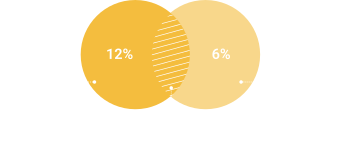
What livelihoods do migrants belong to at source locations?
76%
Animal husbandry
72%
Agricultural labourers
59%
Farmers
22%
Construction workers
7%
Cement factory worker
5%
others
44%
Construction workers
34%
others
19%
Cement factory worker
17%
Domestic workers
13%
Steel plant worker
11%
factory Worker
8%
Other manufacturing factory workers
5%
brick klin worker
What extreme weather events are migrants facing at source locations?
74%
Drought
55%
Increasing heat
48%
Flooding
47%
Increased unpredictability of weather / seasons
33%
Wildfires
32%
Landslides / mudslides
30%
Increasing cold
23%
Excess rain
21%
Water pollution
9%
Riverbank erosion
5%
Others
57%
Flooding
53%
Increased unpredictability of weather / seasons
50%
Increasing heat
45%
Water pollution
43%
Increasing cold
32%
Drought
29%
Excess rain
26%
Landslides / mudslides
11%
Wildfires
11%
Riverbank erosion
11%
Others

What livelihood impacts are migrants facing as a result of extreme weather at source locations?

71% Crop loss
70% Wage loss
56% Wage cut
28% Animal loss
6% Work related asset loss 
10% Job loss

What household impacts are migrants facing as a result of extreme weather events at source locations?

85%Food Insecurity
47%Loss of household assets
47%Health related issues
36%Limited or damaged access to water or sanitation
33%Transportation routes in / out of village damaged / slowed
16%Communication methods slowed or lost
15%Communication methods slowed or lost
6%House was Damage

What household impacts are migrants facing as a result of extreme weather events at destination locations?

74%Food Insecurity
48%Loss of household assets
46%Health related issues
39%Loss of household assets
32%Transportation routes in / out of migrant location damaged / slowed
21%Children removed from school temporarily
20%Decreased remittances that were sent to village
15% Lost access to health services
13%Communication methods slowed or lost
7%Injury of family member(s) or other health impacts due to weather event(s)
7%House damaged
5%Children removed from school permanently
How are migrants coping with these livelihood and household impacts due to extreme weather at source locations?
88%
Support from family and friends
45%
Loan from informal sources such as moneylenders
42%
Loan from formal institutions such as banks
40%
Used savings
13%
Reduced number of meals
6%
Additional family members took on jobs locally
5%
Migration
87%
Support from family and friends
46%
Loan from informal sources such as moneylenders
39%
Loan from formal institutions such as banks
36%
Used savings
8%
Additional family members took on jobs locally
6%
 Found additional work at the destination
What external support is available to migrants during/after these extreme weather events at source locations?
70%
No assistance received
15%
Finding an alternate job
7%
Skilling courses by employer
6%
Support from government
69%
No assistance received
16%
Finding an alternate job
15%
Emergency relief from CSOs/CBOs
7%
Skilling courses by employer
6%
Healthcare services support
PCI empowers community-led organizations across South and Southeast Asia. PCI promotes initiatives that work deeply – and at scale – on the ground and leverage this to change systems.
Select a country view migration analyses