

×

Fill Out The Form Below To Download Report

By ticking this box, you acknowledge and agree that People’s Courage International retains all intellectual property rights and ownership over the data provided herein. Any publication, presentation, or public dissemination of this data must include an explicit citation of People’s Courage International as the data source. You agree not to reproduce, distribute, sublicense, or share this data with any third party without written consent.

I have read and agree to the Data Use Terms and Conditions of People’s Courage International.

For any questions, write to research@peoplescourageinternational.org

Migration across countries
Nepal
Nepal Flag
India
India Flag
Nepal
Nepal Flag
Indonesia
Indonesia Flag
Philippines
Philippines Flag
Bangladesh
Bangladesh Flag

Nepal

Migration at a Glance: Demographic Insights & Movement Patterns

Overview
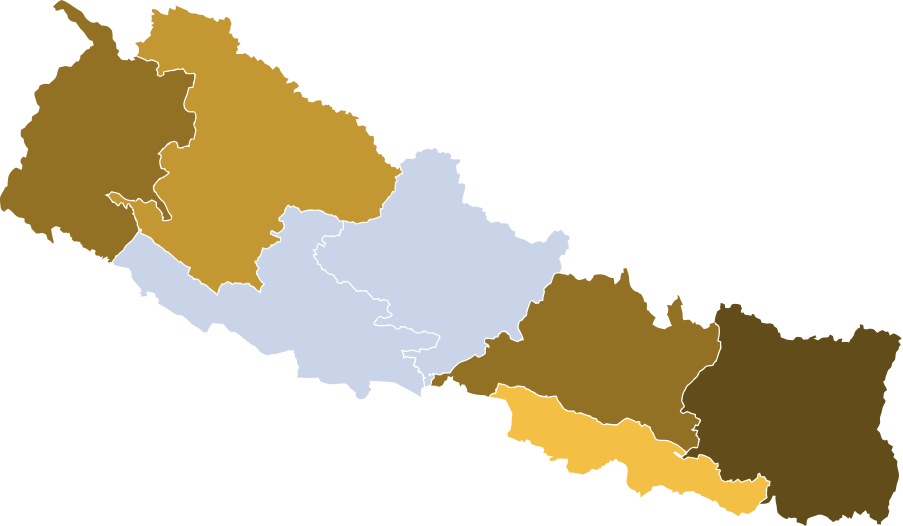
State Map

Select state to jump to state level migration analysis

Migration dynamics in Nepal

In Nepal, 2,796 migrants were surveyed – representative of 9.3 million internal migrants in the country. This accounted for 12% of the total sample across the five countries surveyed.

What is the age of migrants surveyed?
Internal migration in Nepal is largely driven by a young and economically active population. Compared to other countries, Nepal showed a higher representation of 18 to 24 year-old migrants suggesting an earlier entry into the labour market for a large number of people.
18-24 years
21%
25-34 years
34%
35-44 years
26%
45-59 years
18%
60 and above
1%
Male
67%
Female
33%
Janjaati / Ethnic community
48%
Dalit
28%
Khas-arya
16%
Madheshi
7%

Why are people moving?

Internal migration in Nepal is primarily driven by economic problems like challenges in livelihoods, lack of job opportunities, and low wages at source locations. Repayment of loans is also a notable push factor, suggesting underlying financial stress and vulnerability. Disasters and change in weather are also a prevalent reason for migration, though to a lesser extent, highlighting the role of extreme weather as an emerging concern.
85%

Livelihood no longer dependable

67%

Lack of job opportunities at source

55%

Lower wages at source

30%

Earn wages to pay back loans

7%

Long-term change in weather

7%

Disaster event at source

6%

Migrated for marriage purpose

5%

Land related conflicts at source

5%

Shelter was damaged or destroyed

Why are migrants choosing certain destination locations?

Primary basis of choosing certain destination locations are economic, with an overwhelming majority prioritizing destinations which offer better job opportunities and higher wages. Other considerations such as proximity to home, healthcare access, and education opportunities also influence destination choice, though to a lesser extent.
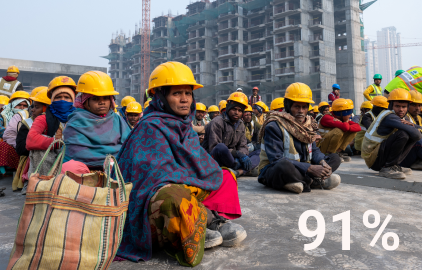
Finding better job opportunities
91%
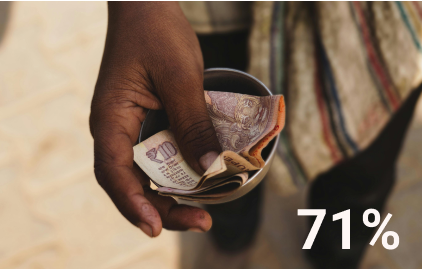
Finding better wages
71%
Proximity to home/village
36%
Better healthcare services
13%
Better educational opportunities
11%
Joining other family members
10%
Greater freedom within destination
6%
For marriage purpose
6%

Who are migrants moving with?

While many migrate with spouses, children, or other family members, indicating strong family-based migration dynamics, a notable proportion of the sample are accompanied by other villagers and contractors. This could indicate community ties as well as labour recruitment priorities play a crucial role in shaping migration decisions.

45%

Friends

30%

Spouse

27%

Other villagers

21%

Contractor/employer

18%

Children

13%

Alone

10%

Other workers

9%

Other family members

What duration are migrants moving for?

Seasonal migration is more prominently in Nepal, with a vast majority of the sample migrating for a few months in year. Due to the heavy dependence on farming income at source locations, many return home in agriculturally active seasons. Permanent or long-term migration is not common.

Short-term / temporary migrant (every year for one or more months)
67%
Migrate some years for one or more months
14%
Migrated temporarily once but don’t plan to migrate again
12%
Permanent migrant
6%
Long-term migrant (one or more years)
1%

What locations are migrants moving to in Nepal?

How many migrants are negatively impacted by extreme weather events?

The majority of respondents reported being impacted at both source and destination areas, suggesting more broad-based exposure to weather related risks across locations.

A significant share of migrants also reported experiencing impacts only in their source or only at the destination, though to a lesser extent.

6%

No. of migrants not impacted negatively by extreme weather
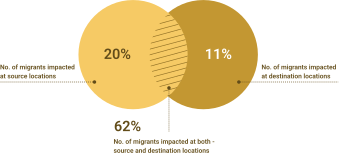
In Nepal, internal migrants are experiencing significant impacts from extreme weather events, both at their places of origin and at their destinations. These overlapping vulnerabilities shape migration decisions and daily living conditions.

82% of 1,832 surveyed migrants

At source locations reported facing weather-related impacts either at home or in both home and destination areas.

85% of 865 surveyed migrants

At destination locations reported experiencing climate impacts either where they currently live or in both locations.

These findings reflect the widespread and compounding climate challenges internal migrants face across their migration journey in Nepal.

What livelihoods do migrants belong to at source locations?
Livelihoods in at source location are heavily rooted primary livelihoods like animal husbandry, working as agricultural labourers or farming on their own lands. Many also mentioned construction work. It is important to note that the majority of the livelihood practices are heavily dependent on favourable weather.
62%
Animal husbandry
59%
Agricultural labourers
57%
Farmers
35%
Construction workers
13%
Cement factory worker
11%
Transport worker
7%
Steel plant worker
5%
Brick kiln
48%
Construction workers
20%
Others
17%
Domestic workers
15%
Cement factory worker
13%
Factory workers
13%
Other manufacturing factory workers
12%
Steel plant worker
10%
Brick kiln
5%
Food processing factory worker
What extreme weather events are migrants facing at source location?
Drought is the most commonly cited weather event, followed by increasing heat and excess rains. Flooding and landslides are also prevalent, mentioned by a significant portion of the samples. The variety of weather events reflects Nepal’s growing climate vulnerability.
74%
Drought
56%
Increasing heat
45%
Flooding
35%
Increasing cold
34%
Excess rain
31%
Landslides / mudslides
29%
Increased unpredictability of weather / seasons
25%
Salinisation of water supply
21%
Wildfires
6%
Others
75%
Increasing heat
48%
Flooding
42%
Increasing cold
34%
Drought
28%
Increased unpredictability of weather / seasons
26%
Excess rain
16%
Landslide / Mudslides
12%
Riverbank erosion
10%
Others

What livelihood impacts are migrants facing as a result of extreme weather at source locations?

Weather-related disruptions have significant impacts on livelihoods in Nepal’s source locations, especially in terms of wage loss and crop loss. Many also mentioned experiencing wage cuts. At the same time, loss of livestock was also significant among participants at source locations.
68% Crop loss
30% Animal loss
74% Wage loss
10% Emplyoment related asset loss

50% Wage cut
17% Job loss

What household impacts are migrants facing as a result of extreme weather events at source locations?

Food insecurity is the most widespread consequence of weather events at source locations. Many also reported health problems, loss of water and sanitation facilities, and loss of household goods. Impacts on these basic amenities pose a big challenge for the participants during weather events.

83%Food Insecurity
42%Health related issues
37%Limited or damaged access to water or sanitation
33%Loss of household assets
28%Transportation routes in/out of village damaged/slowed
13%Communication methods slowed or lost
18%Lost access to health services
9%House damaged
8%Injury of family member(s) or other health impacts due to weather event(s)
6%House destroyed

What household impacts are migrants facing as a result of extreme weather events at destination locations?

Weather events severely affect migrant households, leading to large scale food insecurity, health issues, and loss of basic services like water and sanitation. Many families also reported reduced remittances they used to send back to their families. These cascading impacts translate to deeper socioeconomic vulnerabilities of migrant workers at destination locations.

64%
Food insecurity
63%
Health related issues
37%
Limited or damaged access to water or sanitation
36%
Loss of household assets
25%
Decreased remittances that were sent to village
24%
Lost access to health services
16%
Children removed from school temporarily
12%
Transportation routes in/out of migrant location damaged/slowed
10%
Injury of family member(s) or other health impacts due to weather event
9%
House damaged
8%
Children removed from school permanently
5%
Communication methods slowed or lost
How are migrants coping with these livelihood and household impacts due to extreme weather at source locations?
Participant responses show heavy reliance on informal support systems like borrowing from family and friends and informal loans. Other negative coping mechanisms include dipping into savings. A significant number of migrants also reduce food intake, highlighting the serious trade-offs households make in trying to cope with weather events.
67%
Support from family and friends
63%
Loan from informal sources such as moneylenders
36%
Used savings
29%
Loan from formal institutions such as banks
25%
Reduced number of meals
11%
Additonal family members took on job
7%
Support from government
6%
Children removed from school
55%
Loan from informal sources such as moneylenders
49%
Support from family and friends
41%
Used savings
11%
Loan from formal institutions such as banks
9%
Additional family members took on jobs locally
6%
Found additional work at the destination
6%
No coping mechanisms
What external support is available to migrants during/after these extreme weather events at source locations?
Most weather-affected migrants reported receiving no formal assistance, highlighting significant gaps in response systems. A small minority accessed emergency relief from government or civil society organisations. The data suggests the need for more inclusive, responsive support mechanisms for migrant workers to cope with weather-related challenges at source locations.
62%
No assistance received
22%
Emergency relief from the government
13%
Emergency relief from CSOs/NGOs
9%
Finding an alternate job
5%
Skilling courses by employer
75%
No assistance received
16%
Emergency relief from CSOs/NGOs
10%
Finding an alternate job
8%
Healthcare services support
5%
Compensation from employers
5%
Skilling courses by employer
PCI empowers community-led organizations across South and Southeast Asia. PCI promotes initiatives that work deeply – and at scale – on the ground and leverage this to change systems.
Select a country view migration analyses